
Why are we here? Where are we going, and how will we get there? How can we get all the noses in the same direction? In an experiment to investigate the strategic value of my ‘dubio-approach’ (asking what-, how-, and why-questions a lot, see page “Dubito ergo sum”) I took ‘the dubio formula’ and mixed it with the strategic planning concepts: vision, mission, values and strategy. After some stirring, I came up with 1) my own definition of the concepts, and 2) a visual representation of how I think the concepts connect the what, how and why. A highly experimental, but fun to do exercise… et voila, le résultat:
Strategic definitions
| Wikipedia’s definition: | Dubio’s definition: | |
| Vision | Defines the way an organization or enterprise will look in the future. The vision is a long-term view, sometimes describing the organization’s picture of an “ideal world”. For example, a charity working with the poor might have a vision statement which reads “A World without Poverty.” | Defines what the company will look like in the future (future what) if it continues to pursue its purpose (why). |
| Mission | Defines the fundamental purpose of an organization or an enterprise, succinctly describing why it exists and what it does to achieve its vision.The mission statement provides details of the organization’s operation and says what it does. For example, the charity might provide “job training for the homeless and unemployed”. The statement may also set out a picture of the organization in the future. | Defines the company’s purpose (why) and plans/choices (what) to pursue that purpose. |
| Values &Culture | Beliefs that are shared among the stakeholders of an organization. Values drive an organization’s culture and priorities and provide a framework in which decisions are made. For example, “Knowledge and skills are the keys to success” or “give a man bread and feed him for a day, but teach him to farm and feed him for life”. These example values may set the priorities of self sufficiency over shelter. | Defines (ideally) a set of why’s that all stakeholders of the organisation share and use when making choices (what). All the personal why’s (whether shared or not) add up to a companies culture. |
| Strategy | Strategy, narrowly defined, means “the art of the general” (from Greek stratigos). A combination of the ends (goals) for which the firm is striving and the means (policies) by which it is seeking to get there. A strategy is sometimes called a roadmap which is the path chosen to plow towards the end vision. The most important part of implementing the strategy is ensuring the company is going in the right direction which is towards the end vision. | Defines the plan (what), the organisation has to reach its vision (why), and the methods (how) it is deploying to implement those plans. |
How strategic concepts connect what, how, and why
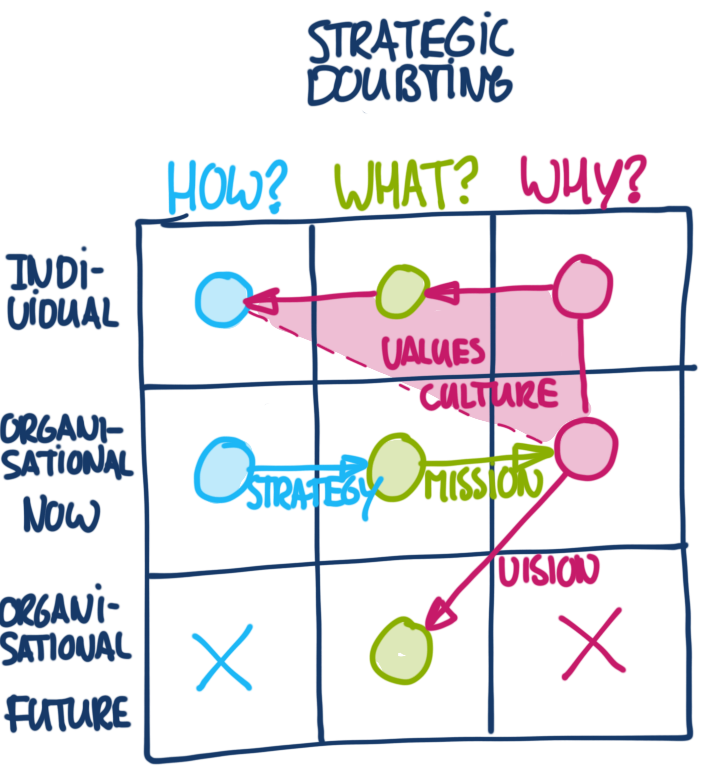
Explanation: The picture proposes how strategy, mission, vision and values connect the (current and futue) why, how and what of the individual and the organisation. The arrows show the direction, e.g. the vision describes how the current organisational why leads to the future organisational what. Might be a bit of a stretch…. but ok…
Q:Dear reader, what do you think/notice when you look at this picture?
Picture on top of post, source: Fffound.com
As a true doubtaholic, I constantly strive for more awareness of myself, and of others around me. In doing that, I find it helpful to ‘stretch’ my thinking a little bit by asking myself less-usual questions, like “How much am I?” (see post with the same title). After a while it becomes harder and harder to come up with new questions, so I decided to come up with an ‘engine’ to help me generate more, and more extraordinary, questions related to the what, how, and why of what keeps me busy.
In a first attempt, I came up with the following ‘dubio-engine’: (please note that in a more recent post, I’ve done a second attempt to describe the dubio-engine)

So how does this work?
- Select a subject (who?) First select the subject of your awareness. Are you focusing on yourself, your team (we), or a specific stakeholder of the organisation that you work in (they). To really ‘unusualise’ your questions, start with ‘unknown’ or ‘nobody’.
- Select a primary doubt (what, how, why?) Secondly, choose your primary question. Would you like to focus your attention on actions or choices (what?), behaviours or methods (how?) or motives or values (why?).
- Select a secondary doubt Third step is to add a secondary what-, how- or why-question (if you can handle it) to add an extra layer to the questions
Now try to formulate a question using your selections on the three abovementioned steps. You can use the examples above to get an idea. For example, if I choose “customer > why? > why?”, I could end up with a question like “Why don’t we know what the customer wants?” (see above image).
By doing this exercise, and by trying to answer the questions I find, I get to new insights that can help me (start to) become (even) better at what I do.
Q: Dear readers, what do you think, could this help you become more (self-) aware? Any suggestions or doubts?
Image on top of post, Laurie Lipton on Design You Trust
How can I learn how to do things smarter or better? I was reminded of the taxonomy of learning objectives of Bloom et al. which splits learning in three domains: cognitive, affective and psychomotor domain (see below for more info). Let’s see what we can do with that:

I wonder if the elements in the different learning domains can be linked to the what-, how- and why-questions. Let’s give it a try:
- Could we describe ‘analysing’ (Separates material or concepts into component parts so that its organizational structure may be understood. Distinguishes between facts and inferences), as part of the ‘cognitive domain’ as how to make sense of the what?
- And is ‘evaluating’ (Make judgments about the value of ideas or materials) the same as linking actions or things (what) to a value or a purpose (why)?
I have the feeling that this works. I will have to do some more work to really make sense of it, and to see if there’s any value in this excercise… to be continued…
In my ongoing project to figure out what it takes to become (even) more self-aware and to connect some loose concepts, I’ve decided to focus on the what-question a little bit more (See page “Dubito ergo sum“): “What am I doing?”. I tried to come up with a few more what-related questions and related concepts. See below for my braindump:

Althouth I belief the value of this scribble is more in the process of me scribbling away, than the result itself (see also comments on the post”Is simplicity proof of foolishness or genius?“, I do like some of the things I stumbled on. The gist of it, is that ‘what I’m doing’ has to do with choice, opportunity, bias, capacity and curiosity. Food for more posts I think….
Do you tend to focus on your todo-list and on how to get the items on it done asap? Or do You like it more to philosophise about what things You could do to reach your ideal, and are you less interested in how exacly to get there? As an experiment (like all the other stuff in this blog), I’ve taken the what-, how- and why-questions (See post “The dubio formula”) and looked for some different ‘dubio-perspectives’.
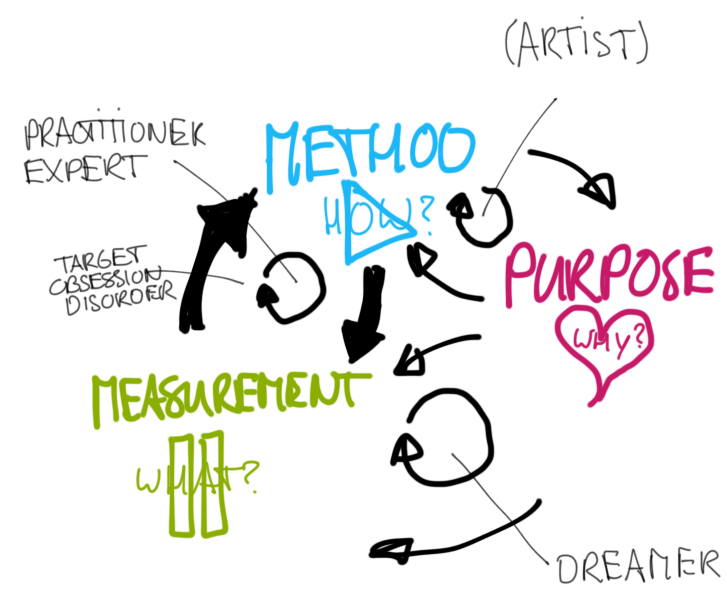
As you can see I found three perspectives:
- What-how perspective (manager/expert) Do I like to focus on what needs to be done, and how it can be done? Take the example of a manager, steering a group of experts (how) towards completing a set of deliverables (what), or -other way around- an expert optimising her/his method (how) to a certain target (what).
- Why-what perspective (dreamer) Or do I like to think about what can be done (what) to reach a certain dream, or vision (why)? Do I need to have a purpose for everything that is on my todo list, otherwise I cannot be motivated? Is it easy to make plans, but difficult to get things done?
- How-why perspective (artist) Do I prefer to get busy with doing what I’m good at because I like it and/or I feel an trust it will get me to the point where I want to be eventually? Like an artist who likes creating a beautiful piece of art, but feels it is inappropriate or impossible to envision a piece of art in his/her head, and then to reverse-engineer it.
- You could argue that a there are also ‘lone’ perspectives only focusing on one of the three, and one focusing on all.
Q: Dear reader (hehe…if any), what do you think of this? Do you recognise yourself in one of the perspectives in particular?

Why do we ask “How are you doing?” when we want to (sincerely or not) know if somebody is happy? Why don’t we ask “Do you have what you want?”. I would think that would a more accurate question when asking for somebodies happiness. If you have what you want or need you’re happy, right?…. Right?!
Or maybe not… maybe once I’ve reached what I wanted to reach, I already have a new destination in mind where I want to go. And the fact that I haven’t reached that one yet, makes that I’m not a hundred procent happy…yet… Maybe I’m wrong to focus on the destination (why), and should I focus on the journey (how)…?
Surely, enjoying what you’re doing is not more important than knowing what you want? Probably, the one does not go without the other, but that is not quite a satisfactory conclusion for me yet. And how about the difference in being happy in your life versus being happy about your life, and the ‘experiencing self vs remembering self’ that Kahneman talks about (See post “When am I?“)?
Anyway… to be continued… In the meantime:
Ithaca
When you set out for Ithaka
ask that your way be long,
full of adventure, full of instruction.
The Laistrygonians and the Cyclops,
angry Poseidon – do not fear them:
such as these you will never find
as long as your thought is lofty, as long as a rare
emotion touch your spirit and your body.
The Laistrygonians and the Cyclops,
angry Poseidon – you will not meet them
unless you carry them in your soul,
unless your soul raise them up before you.
Ask that your way be long.
At many a Summer dawn to enter
with what gratitude, what joy –
ports seen for the first time;
to stop at Phoenician trading centres,
and to buy good merchandise,
mother of pearl and coral, amber and ebony,
and sensuous perfumes of every kind,
sensuous perfumes as lavishly as you can;
to visit many Egyptian cities,
to gather stores of knowledge from the learned.
Have Ithaka always in your mind.
Your arrival there is what you are destined for.
But don’t in the least hurry the journey.
Better it last for years,
so that when you reach the island you are old,
rich with all you have gained on the way,
not expecting Ithaka to give you wealth.
Ithaka gave you a splendid journey.
Without her you would not have set out.
She hasn’t anything else to give you.
And if you find her poor, Ithaka hasn’t deceived you.
So wise you have become, of such experience,
that already you’ll have understood what these Ithakas mean.
Source: K. P. Kavafis
P.s. The picture in the header is of one of my ‘Ithaka moments’ in Banjul (Gambia, Africa) where I saw a boat called Alchimist. It reminded me of the book Alchemist by Paolo Coelho.
When thinking about what I do, I realise I often make choices ‘in the moment’. I generally don’t think about things very long before I make a choice. Turning that around, I’m afraid it also means I don’t make a lot of decisions that require very long thinking… Probably, that’s partly because I’m a ‘present oriented’ kind of guy (see post “How to solve life’s puzzles? Understand your time perspective!“). Maybe it’s a good thing to not think about choices for too long?
What? In our current society, we (read: the lucky ones) have almost limitless options, and our capitalistic ideology is promoting the generation of more options, more opportunities to consume. The amount of choices becomes so overwhelming, that it becomes harder and harder to make a choice.
How? The overwhelming amount of choices makes us passive, we do nothing. Paralised by indicisiveness, we self-criticise over how we fail to live up to the ideal picture of the ‘self-made man’.
Why? Because we have so many choices, we have to decide what we really want. What are our beliefs, values, and how can we stay true to ourselves? Who am I anyway? The combination of having too many options/choices and not knowing what you want creates anxiety.
This anxiety, according to some (see below), can manifest itself in three ways:
- I choose what they choose because I’m afraid to be ridiculed for making my own choice. It’s easy to make a choice that other’s have made before. It can be to make the choice for the ‘ruling ideology’ for example.
- I want the ideal choice, so I investigate long and hard and weigh all the options, before I make my choice. It can mean that, if possible, I change my choices regularly to meet the ideal.
- Choosing is loosing options, so I don’t like to choose. My ideal is to have as many options as possible, so I have full control over my future. Choosing means choosing a path that I might not like further along the way.

For this post I was inspired by a lectiure by Renata Salecl, see the animated video below:
Professor Renata Salecl explores the paralysing anxiety and dissatisfaction surrounding limitless choice (RSA Animate 2011)
See also later post “Choosing is a choice?” (if it’s there yet)
What is leadership? I wouldn’t dare to come up with a definition, especially since I think good leadership depends a lot on the context. I do feel that it is more accurate to talk about leadership instead of leaders. As a first step in my quest for leadership on this blog, I’ve analysed a video on the website of Harvard Business Review. It explains why five characteristics of leadership are important (according to Claudio Fernández-Aráoz of the company Egon Zehnder).

With pride I present to you…… the dubio-formula! Since I’ve been doubting so much about the three basic what-, how- and why- questions, I thought it’s time to draft my own ‘model’ or ‘mantra’ just to make sure I never forget about them. And maybe it can help me to explain what I’m trying to do (and why and how) to other people!*
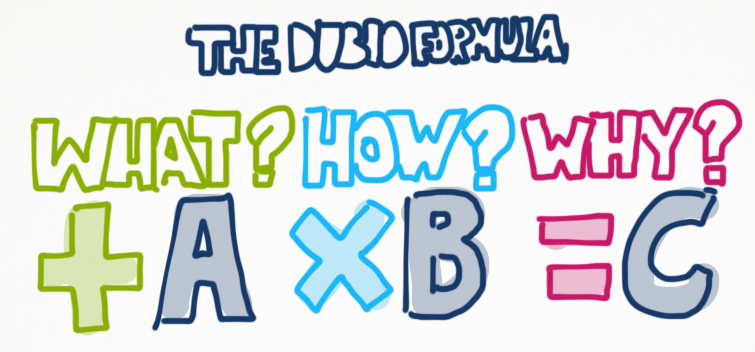
Let my try to explain. The way I see it, the what-, why- and how- questions add up to a formula, where the what is the plus or the minus, the how is the multiplier, and the why is the equals symbol.
- WHAT? The what is about the choices that we make, the things we decide to (go and) do, and the plans that we have. All the choices that we make add up to a plan or a todo-list.
- HOW? The how is about the methods that we use to get things done. The actions that we actually perform. Whether we get the things done that we planned for (what), depends on our effectiveness and efficiency. Hence the multiplier symbol, the methods (how) make the impact of our decisions (what) smaller or bigger.
- WHY? The why is what we end up with, the results of the combination of our decisions and our actions. Ideally, when we make our decisions (what), we have some idea on what we would like (or need) to achieve (why). The equals symbol stands for results, both planned and not planned.
Q: Dear reader, please let me know what you think of the dubio-formula! Too simple?
*It works for Sinek, start with the “why not? I say”
Was your new year resolution “solve life’s puzzles” too? Well, it turns out that many of life’s puzzles can be solved by simply understanding our own time perspective, and that of others. If only I knew before… ;). It’s really the most simple idea in the world according to Philip Zimbardo, professor of psychology at Standford university. Being aware of your own time perspective and that of others will help explain some of the differences between you and the other, he argues. What predominant time perspective you have explains why and how you make some of your decisions. It reminded me of the concepts of ‘remembering self’ and ‘experiencing self’ by Daniel Kahneman (See post “When am I“).
I’ve sribbled away while watching his lecture (animated by RSA Animate), see below:
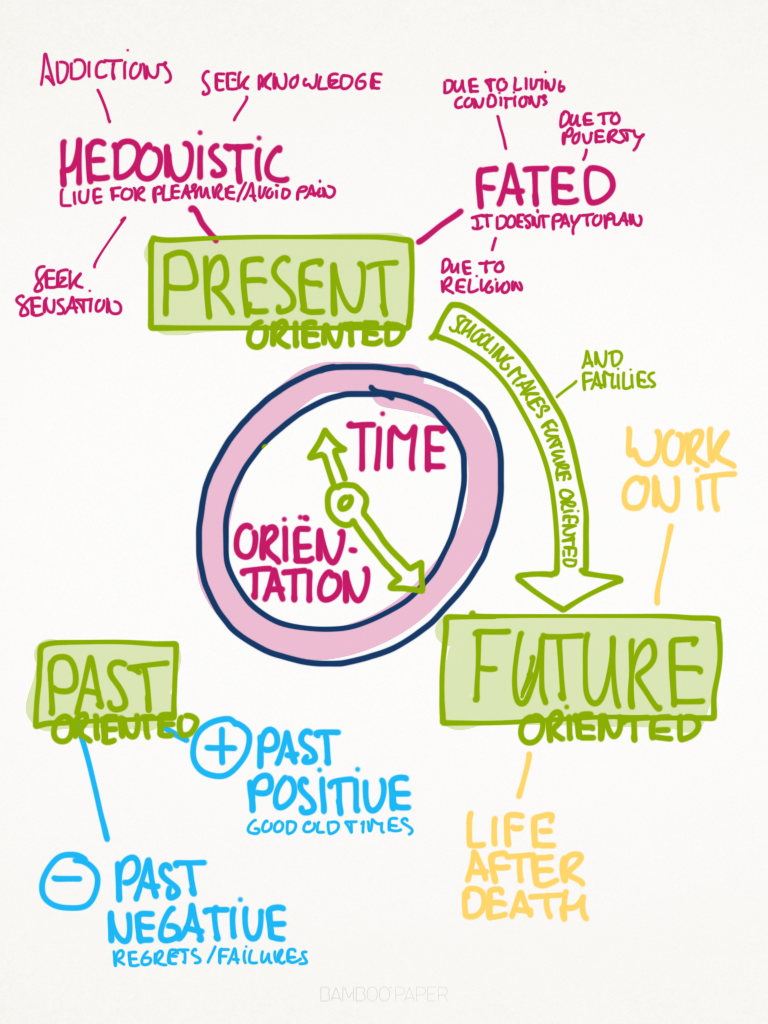
I followed his advice and found out what my time perspective is, according to his Zimbardo Time Perspective Inventory (ZTPI). This is the result: past-negative 1.70 (on a scale of 1 to 5), past-positive 2.78, present-hedonistic 3.93, present-fatalistic 2.44, future 2.38 (didn’t know how to plot is in the graph). See below for a graph of my score (black), compared to the ideal time perspective according to Zimbardo:
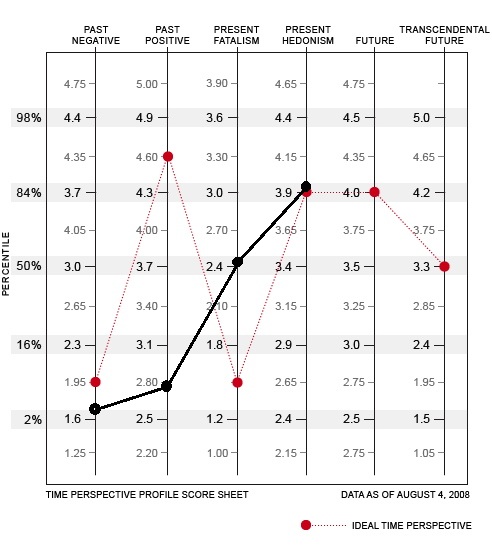
The 50%-line marks the average scores of the data collected so far
I wonder why I’m so far ‘below par’ on the past postitive perspective, I have a wonderful past, I just don’t think about it an awful lot. See the animated video of Zimbardo below:
Thanks to the blog “Have you met Eric“
 In dubio