How do you ‘spell’ fifteen billion (just a random figure) in numbers? And how much is 18,4 quintillion exactly? Especially when I hear about big numbers in the media, like the US debt for instance, it dazzles me immediately (See also post “How much am I?“). But it gets exponentially worse when these numbers start moving, e.g. when we start talking about predictions on how these numbers will change over time. E.g. How much would fifteen billion be in five years if it would increase by two percent every year. How many grains would you have in the last square of a chessboard if you put one grain on the first square, two on the second, four on the third, and go on doubling the amount of grains for each next square of the chessboard? To say “an awful lot” is probably just as helpful as the actual answer.
 9E represents the number 18,4 quintillion. Source Wikipedia
To feel a bit better about myself, I every now and then watch this video of a professor telling me I’m not the only one that has problems with this.
That’s just a weird question… I will stick to”How much?”. Like all the previous posts, it’s probably futile, but let’s esplore anyway. When talking with my colleagues about what we do (See post “Who are we?“), what we could do, and what choices we make, it’s clear that we (luckily) want more than we (unfortunately) can do. We’re obviously limited by time, staff and money. At the same time, it is very hard to estimate how much of time, people or money we need to complete any chosen task or project. Not only because it’s hard to predict the future, but also because numbers are just generally hard…. right?… Or is it just me…?
When plannning what we do, me and my colleagues always need to balance how much time and money we are going to invest to get a certain quality of product or service. If we want better quality, we will have to invest more time or money. That’s about as obvious as any odd post on this blog, but for me personally, the trick is to be aware about this, and make conscious choices in this that are shared with the team.

Although it’s clearly important to be conscious about how much time or resources to assign, or how much to expect of something, it’s probably also one of the hardest things to do. We humans are (read: I am) just not very good at estimating, analysing data, and dealing with big numbers. Especially when you add the time-factor, and get things like exponential effects…. wicked… (See post “The biggest shortcoming of the human race?“)
And how about relative vs. absolute how-much-ness? Am I aiming for good or for better, for many or for more? Am I motivated by competition or by competence? It feels like this makes a big difference, not only in why I pay more attention to some things than to others, but also in the way I’m looking at things. Could it be that if I’m inclined to think relative, that I’m more biased. This because I tend to compare my chosen or expected quantity to that of others, or because I use numbers because they are available? Hmm… some more doubting needs to be done to crack this one…
After having figured out to some extent what our “team identity” is (see post “Who are we?), I cannot help but wonder if I like what I’m seeing. I’m not sure if we are doing the right things, the right way, and for the right reasons. I realise we are often doing things, simply because we have always done them. We use certain methods, because they are conveniently available. And because of time pressure we focus on delivery, and not so much on improvement. We focus on performing rather than improving, even though most of us feel that a relatively small time investment can help us do things smarter.

Frysian for: “Do what you have to do, and let the people talk”
I started off by asking questions: “What do we do?”, “How do we do it?” and “Why do we do it” (see post “Who are we?). If I ask the same what-, how- and why-questions about what methods we use, I get some interesting follow-up questions: “What else do we do like that?”, “How can we improve the way we do it?” and “Why do we do it like that”. No rocketscience obviously, but still it helps me to figure out some ‘leads’ to improve how we operate. I scribbled away again, leading to the picture below:

I zoomed in on our methods, but briefly investigated our measurement (what do we do?) and purpose (why do we do it?) as well (see bottom left- and right-side). Sometimes it’s hard to come up with follow-up what-, how- or why-questions, but with some effort I still came up with some intriguing -and hard to answer- questions. Some examples:
- Why do we do it like that? Is it because we are used to it, because we are expected to do it like that, because it is generally accepted to do it like that, because everybody does it like that?
- How can we improve the way we do it? What can we do to improve our methods and our processes? What methods can we deploy to improve our methods? Should we start a project (fixed timeframe) to improve a process (continuous).
- What choices are/aren’t we making? Why do we do this, and not something else? Are we good at making choices? Choosing is a choice.
Q: Dear reader (notice I didn’t write readers?), could you let me know what you think of my scribbles? Some feedback would be greatly appreciated!
Like all my posts, I’m left with more new questions and ‘loose concepts’ to connect, like:
- Anchoring and bandwagon effect
- Groupthink and experience bias
- Process improvement vs. systems thinking
Humans are complicated creatures…. Ok, let me rephrase that: I don’t understand myself*. On the one hand I am very well equipped to understand the world around me, and specifically other people around me. On the other hand, I’m as biased as can be, and make all kinds of errors in judgement when looking at the world around me… I assume… You could say that I’m closer to being blind than I am to being clairvoyent. One of these phenomena that makes me so blind is that I tend to see things from my own perspective. I tend to empathise with the other’s situation, but interpret it from my own perspective.
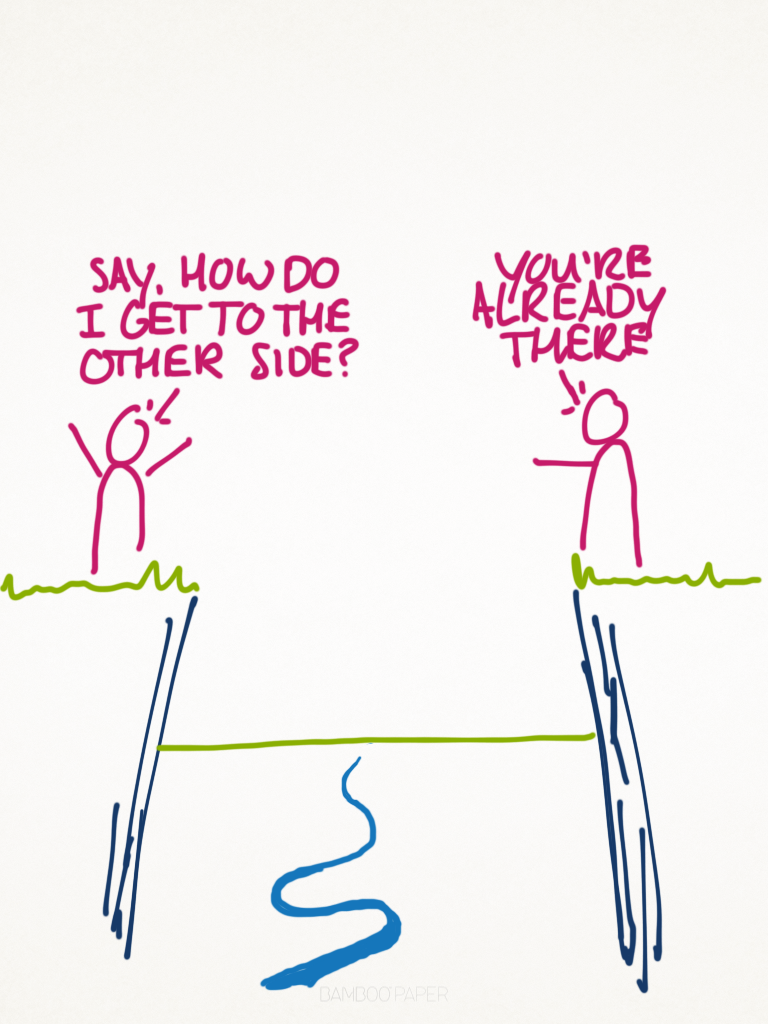
*Booohooohooohooo!!!
As I’m trying to make sense of things, I notice that I’m more and more zooming out. Zooming out of context, and out of level of detail. This way, I can make things fit, and connect one concept to another. I’m just wondering if this is a good thing, and I’m getting a grasp on things, or if it’s merely a magical categorisation trick. If I zoom out far enough, and generalise enough, interpret as I go along, everything becomes one…. Everything seems so easy…. I start wondering why nobody else knows this…. Am I a genius*?
Other geniuses sometimes tell me or write to me in their theory, that the world can be captured in “a 5-step method” or a word in which each letter is the first in another word, together explaining everything. And most powerfull I find those theories that are represented visually, like in three circles overlapping each other in the middle. I feel comfortable about trusting it, because is fits so nicely, it just looks so good if it’s pyramid shaped. There must have been some kind of divine intervention to make it look so good, or -actually- maybe it reveals an actual design… by…. ok, let’s not go that way…
Bottom line: Is simplicity proof of foolishness or genius?
In this episode of “How to do it”, Jacky tells us how to rid the world of all known diseases, and Alan explains how to play the flute. It turns out to be remarkably simple.
And we can probably trust their ideas, because they have a dog.
P.s. As an illustration on how things like context, language, and experience can complicate a perfectly ordered discussion on a perfectly simple complexity model, and end up in chaos, you can read the following discussion: Hammers, nails, and a Cynefin critique.
*Probably yes, but that’s besides the point I’m trying to make 😉
While writing one of my previous posts on this blog (post: Why do I do it? – Motivation), I was thinking abou how having a certain theory, or hypothesis can make you blind to the actual truth. While writing this blog, which is intended to connect a few loose concepts I find interesting, I find myself hoping it will fit my “theory” of the three basic questions (why, what, how). Ofcourse, it really isn’t a theory, but still I hope I can tie in most of the concepts I find interesting (and think are related). I should be careful not to become biased in any way (haha, as if that’s possible).
This reminds me of an episode of the famous talkshow “Thrust, a quite controversial look at the world around us”, in which miss Ann Elk explains her theory, and whose it is. For me this symbolises the dangers of the combination of simplicity and theories.
Il faut savoir ce qu’on veut (you have to know what you want). I find it hard to make time for this… finding out what I want. I sort of know, but I’m not so conscious about it. At the same time, I think it will be of great value to have a better awareness of what I want. To make it a bit easier (again) for myself, I will focus on a work-setting. How can we find out what we want? What is our shared purpose? When I put it like that, I’m thinking that it’s even harder to make time for this…. and it is of even greater value to be more aware of this.
As John Seddon argues in his lecture (post: target obsession disorder) we can only plan for the “known future”, and not for the “unknown future”, but even for the known future, I don’t think we (me and my colleagues) are very aware of what we want to achieve there….
A colleague suggested the following method (how) to find out more about our possible futures, and mybe distill a common purpose. I’m sure there are many similar methods, but the one suggested is called the “future, backwards, method”, by Cognitive Edge. They describe the method as follows:
The Future, Backwards method was developed as an alternative to scenario planning and is designed to increase the number of perspectives that a group can take both on an understanding of their past, and of the range of possible futures. It can be used to discover what entrained patterns of past perception in an organisation are determining its future. It can be used to compare and contrast different aspirations as to the present and the future. It can be used to generate multiple turning points or decision points.
Future, Backwards can be used as a devise to generate or prompt for anecdotes, to lead into mapping and many other purposes. If the instructions are followed it is easy for participants to understand and generates considerable energy within the group. It can be delivered at varying depths of detail and duration, taking from an hour to half a day to complete (obviously with different levels of processing and detail).
Source: The future, backwards method on Cognitive Edge
I find it an interesting method, and am considering to unleash it on my colleagues one day. To be continued…
Maybe the most fundamental question when trying to find out what I’m all about (post: Who am I), is “Why do I do it?”. What is driving me? In one of his lectures on TED, Dan Pink sheds some light on what he thinks are the three most important factors that lead to better performance and personal satisfaction (in other words, that motivate us): autonomy, mastery and purpose. He explains how there is solid evidence to support this theory of motivation, while at the same time, it is largely ignored by most people that deal with people’s motivation (e.g. managers).
I’m investigating if there is a parallell between Pink’s three factors and the three basic what, how and why-questions that I find so interesting, and which I hope so much will by my holy-grail of self-awareness. Bertrand Russell will role over in his grave if he would hear me say this, as one of his messages to me (well… to the future in general) was: “Never let yourself be diverted by what you wish to believe…” (post: message to the future). Ah well, let’s call it a hypothesis then. 😉
My hypothesis, which is mine, is that:
- Autonomy relates to what we do (and a bit of why)
- Mastery relates to how we do it, and
- Purpose relates to why we do it
If this would be true, Pink’s argument would be that 1) being free to do what we want, 2) being good at how we do things, and 3) knowing why we do things, explains why we do things. This sounds a bit circular and I’m not sure yet wheather this means it’s foolish or genius….
Some definitions according to Collins English dictionary:
- Autonomy (philosophy): 1) the doctrine that the individual human will is or ought to be governed only by its own principles and laws, 2) the state in which one’s actions are autonomous
- Mastery: 1) full command or understanding of a subject, 2) outstanding skill; expertise, 3) the power of command; control, 4)victory or superiority
- Purpose: 1) the reason for which anything is done, created, or exists, 2) a fixed design, outcome, or idea that is the object of an action or other effort, 3) fixed intention in doing something; determination a man of purpose, 4) practical advantage or use to work to good purpose, 5) that which is relevant or under consideration
In in a 1959 BBC interview, Bertrand Russell shared his message for the future. He has an intellectual and a moral message, both very intriguing I think. And interesting that, already back then, he is pointing out how the world is becomming more and more interconnected…
After having had a good look at who we are (post: who are we?), I think it’s time to start looking over the hedge to what others are doing (or being). From an organisational point of view, you could call “them” stakeholders (when they have an interest in your company), or competitors (if you’re competing for the same purpose…?), and from a personal perspective it could be strangers, anybody, or nobody.
While trying to answer a question like “how do they do it?”, I immediately start thinking of best-practices and case-studies. But what I find more interesting, is to try to come up with follow-up why, what or how-questions like: “How do they improve their methods?”, “Why do they do it like that?”, or “What could we do like them?”. It seems like this way there is an infinite amount of questions I can come up with that can help me find out more about “the other” (whoever that may be).
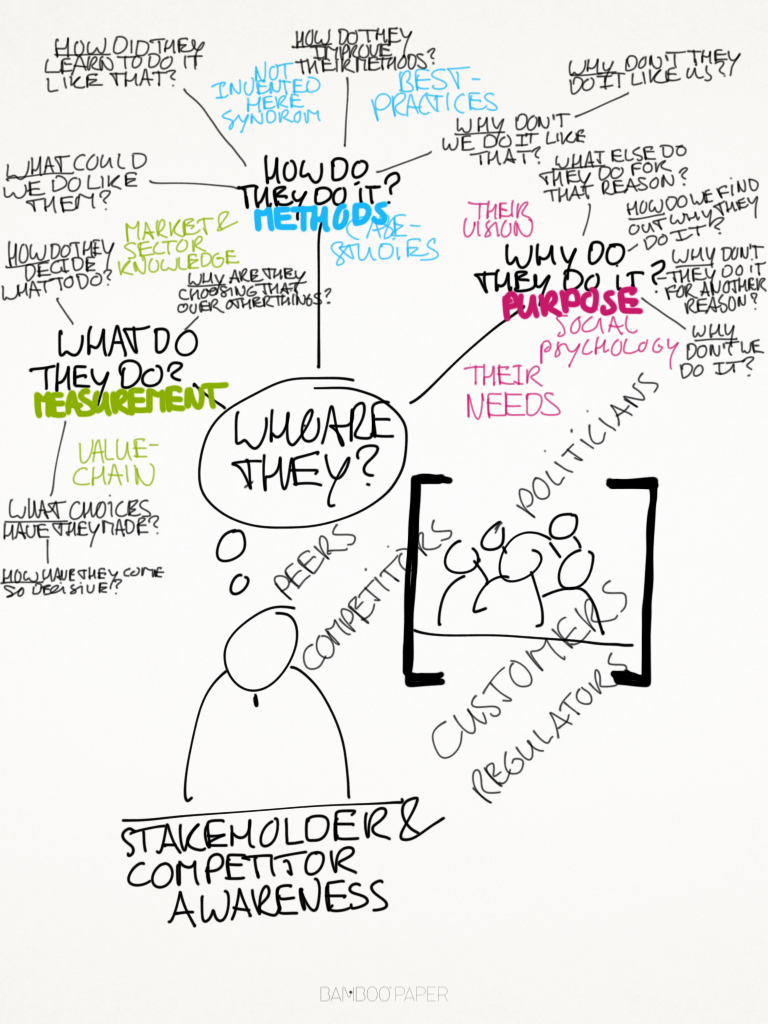
Funny thing is, that maybe… just maybe… , by becoming more aware of the other, “they” will become “we”.
 In dubio