A focus on what we do and how we do things, while forgetting obout the purpose (why we do it), can lead to ineffective organisations. If we optimise our method (how) to what we are measured on (what), instead of what we’re trying to achieve (why), we run the risk of forgetting about the original purpose as we go along. In bigger organisations, methods can become “institutionalised”, and disconnected from other methods and the purpose (see previous post).
In the -quite dated (2005)- talk below, Clay Shirky explains how he thinks that loose networks can be more effective than closed groups or companies. How, because of new communication technology, fluid cooperation can be more efficient than rigid planning. I think, one of the reasons why loose networks can be so effective, is because they form around a common purpose (passion or interest, e.g. mermaids), rather than only a method (task, skill, e.g. photograpy) or a measurement (target, planning, institution).
Parallell to the three basic questions “what do we do?”, “how do we do it?”, and “why do we do it”, John Seddon argues that (in my words) a disconnect between “method” (how), “measurement” (what) and “purpose” (why) can create a fake sense of control in organisations. He argues that targets (measurement/what) make organisations worse and coordination costs makes costs higher.
I guess a logical follow-up question to “Who am I” and “Who are you?” (see previous posts), is “Who are we?”. Before even trying to answer that question, logically, I will need to know what I mean by “we”. Trouble is that I can come up with a never ending list of different “we’s”, all of which are groups of people I feel I belong to. Can be my family, my colleagues, my iceskating-club-members, ice-skaters in general, et cetera. For all of these groups counts that I would be interested to learn more about it (some more than others). So let’s make a choice, and focus on one group in particular: the colleagues in my team.
Thinking about what my team does, I come up with answers along the lines of the processes that we own, or the projects that we run, basically the deliverables that we have as a team. We use different methods, designs, systems and tools to get were (we think) we need to be, and we (sometimes) share a vision and a set of values that guide us to where we want to go to (why do we do it?).
As I’m scribbling away, drawing the picture below, I realise that I’m not sure if all of us would agree on the answers to even these basic questions. I realise that I’m probably most interested in the purpose-question, while I can think of some colleagues that are more into talking about methods or tools. I don’t think it is necessarily a bad thing, but it will require a bit of extra energy to get agreement (if that is at all necessary) on our shared “team identity”. And it feels like being aware of our differences in focus in this can help us better work together. Question is: How can we become better at this?. Well, let’s park that one…
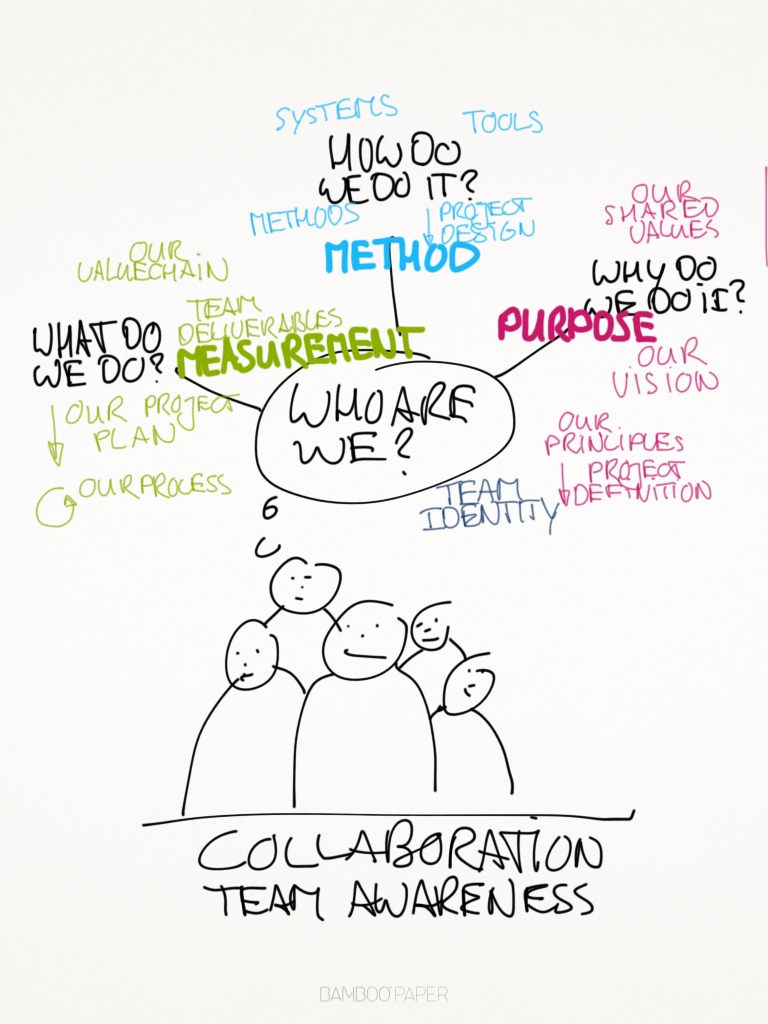
These are just the most basic questions I can ask myself to figure out my team identity. It will be interesting to look for some follow-up questions to dive a little bit deeper into what my team is all about (See later post “How do we do it?“).
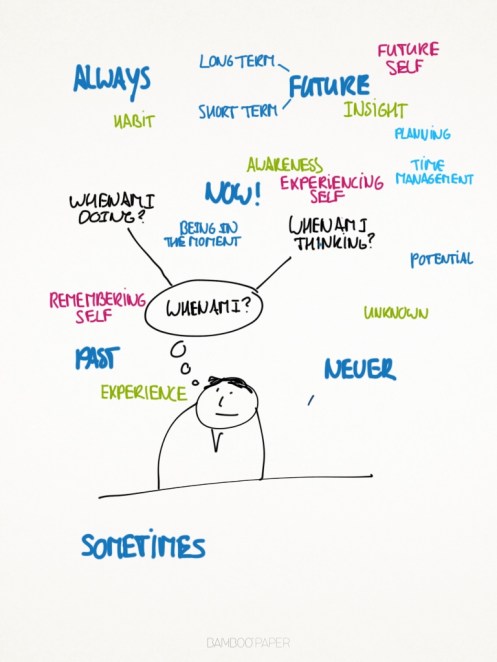
While exploring further who I am exactly, I stumbled upon the question: “When am I?”. I find it a really interesting question, and really easy to answer: I’m in “the now”.
That could have been the end of this post, and maybe it should have been, because further investigation led to too many questions to answer in the timespan that I allow myself to write this post (so my “blogging self” is from now to in half an hour). For instance, if I ask myself “When am I doing it?”, or more interestingly “When am I thinking?”, things get a little bit more interesting.
When I’m doing or thinking something, am I really in the now? Or is my mind wandering off into either the past or the future? And what am I basing my decisions on? On my “current self” or on my “past self” (See also my later post “How to solve life’s puzzles? Understand your time perspective!“)?
In the video below, Kahneman shares his view on what he called “remembering self” and “experiencing self”. Watch!
Some quotes I have to do some more thinking on:
- Life is what happens to you while you’re making other plans, John Lennon
- Time is nature’s way of preventing everything happening at once, John Archibald Wheeler (American theoretical physicist)
- Time flies when you’re having fun
In the metro thinking: “Never try to teach a pig to sing. It wastes your time, and it annoys the pig.” (Robert Heinlein).
Like pigs, a person’s development & learning is limited by his/her ‘hardware’. Not a chance you can teach a pig to sing, right? The only chance you got is changing (or simply widening) your definition of ‘singing’ or changing the way you measure…. I mean, my grandparents used to think The Beatles sounded like crying cats….
Sometimes preventing wastes of time or annoyances is simply a matter of changing the way you look (or listen ofcourse). But that would be cheating right?…. RIGHT?!
My favorite pig-singer…
Anyway, so how about teaching a singer to roll around in the mud. Why wouldn’t that work either? I’m not sure if it would be a waste of time, surely it’s within most singers’ capacity to do that… True, it might annoy the singer, but do we care?
Anyway, i’m at my stop. Gotta get to work, I have to complete a guidebook and a template today.
Judge reputation by actions or judge actions by reputation? If we judge people by their reputation, rather than by their actions, what would be more effective to spend time and effort on: performing the greatest actions or improving your reputation?

Ring!..Ring!..”Bouquet’s residence, lady of the house speaking!!”…”Ehh hello?..Is this miss Bucket?”
Do we want a culture where people who are good at keeping up appearances (unlike lady Bucket) are the ‘haves’ and the people only good at actions are the ‘havenots’? Should we teach our children personal marketing skills or something else?
So now that I know who I am <uch>, it’s interesting to start looking at other people and ask “Who are you?”. What do you do? How do you do it? And why do you do it? Again, it’s almost too simple to appear to have any value. But sometimes simple can be good right? What I find good about these simple questions, is that it -besides getting to know the “professional you”- leads to additional questions, that are even more interesting. For instance, the question “How do you do it” for me naturally leads to another “How?” question: “How can I help you do it better/more efficient?”. And another question I immediately think of is a “Why?” question: “Why do you do it like that?”.
I feel like we’re getting somewhere here…. I don’t know where, but I enjoy the ‘getting there’ anyway.

While scribbling away, a few concepts popped into my head (see bottom of the picture). I’m not sure exactly how they relate to the “Who are you?” question, but it feels like they’re relevant. I guess I need to invesigate a bit further…
- Listening
- Empathy
- Receiving phenomena
- Socialisation & exter- internalisation of knowledge
- Curiousity/interest
- Attention
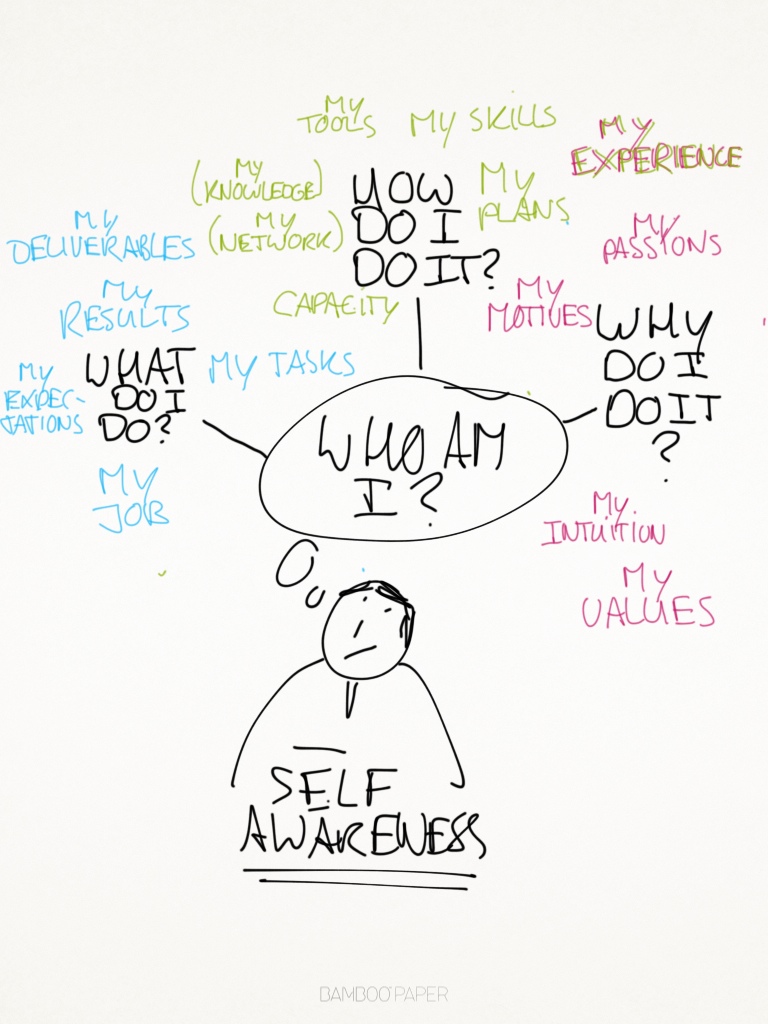
Who am I? What am I, how am I, and why am I? Probably some of the most basic questions (see also post “The dubio-formula!“) I can imagine asking myself, and yet so hard to answer. If I add some action to it, it becomes a little bit easier. For example if I add one of the most basic verbs I can think of, “doing”, to the mix, it becomes a bit easier to imagine what kind of answers I could look for in reply to these questions. And by adding this verb, It’s hard do disregard context, so let’s add “work setting” to the equation. Ok, so now we have a good start:
Who am I at my job?
1. What do I do?
2. How do I do it?
3. Why do I do it?
For me, these questions are connecting some of the dots of my…. let’s call it “professional self”, like my motives, my tasks, my skills, my knowledge, etc. Needless to say, being aware of my “(professional) self” has some benefits, like being conscious of my (in)competencies or of what makes me tick. And being self-aware will probably make it easier to connect with others? Hmmm, let’s park that one. Anyway, below is an attempt to connect some of the “professional identity dots” in a quick scribble.
While writing this post, I (almost) read the info below:
 In dubio